Research

We trace the origins of magnetars and merging compact binaries through the evolution of their progenitor stars. Combining detailed evolutionary calculations with population synthesis, we investigate how binary interactions shape compact-object masses, spins, and companions, and how these properties connect to gravitational waves and electromagnetic transients.

Magnetar Origins & Magnetar-Powered Transients

We investigate how single-star and binary evolution contribute to magnetar formation, and whether tidal spin-up of helium stars can supply the rapidly rotating magnetar engines proposed for extreme stripped-envelope supernovae.

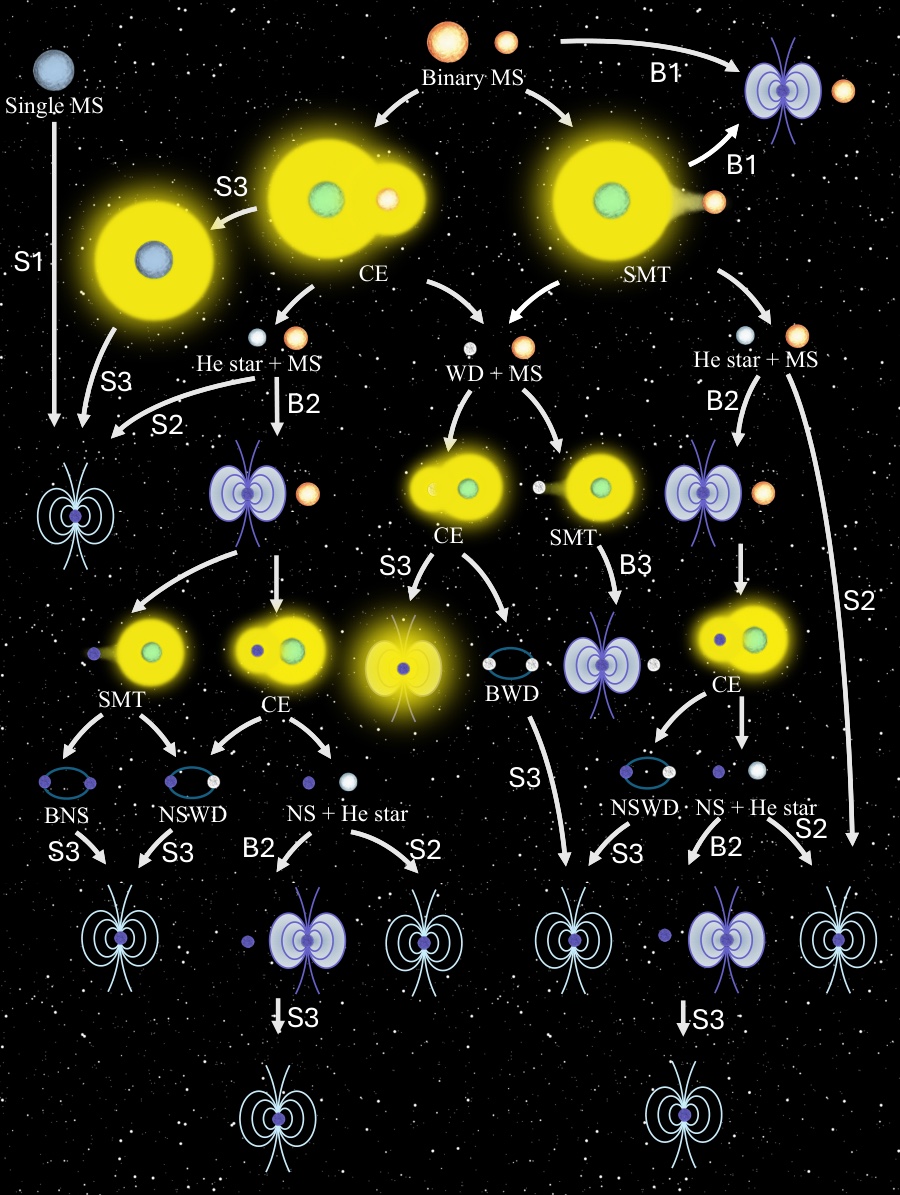
Flowchart showing the single-star and isolated-binary pathways that can produce isolated and binary magnetars
Figure 2 · Single-star and isolated-binary channels for forming magnetars.

Formation Channels of Magnetars

We use population synthesis to compare magnetar formation through single-star and binary evolution pathways, including binary disruption by supernovae, mergers, tidal spin-up, and accretion-induced collapse. Our models predict that at least 90% of magnetars appear isolated, although many originate in binaries that merge or are disrupted by natal kicks. Surviving magnetar binaries most often host main-sequence companions, with orbital eccentricities that reflect the supernova mechanism.

MagnetarsBinary evolutionPopulation synthesis
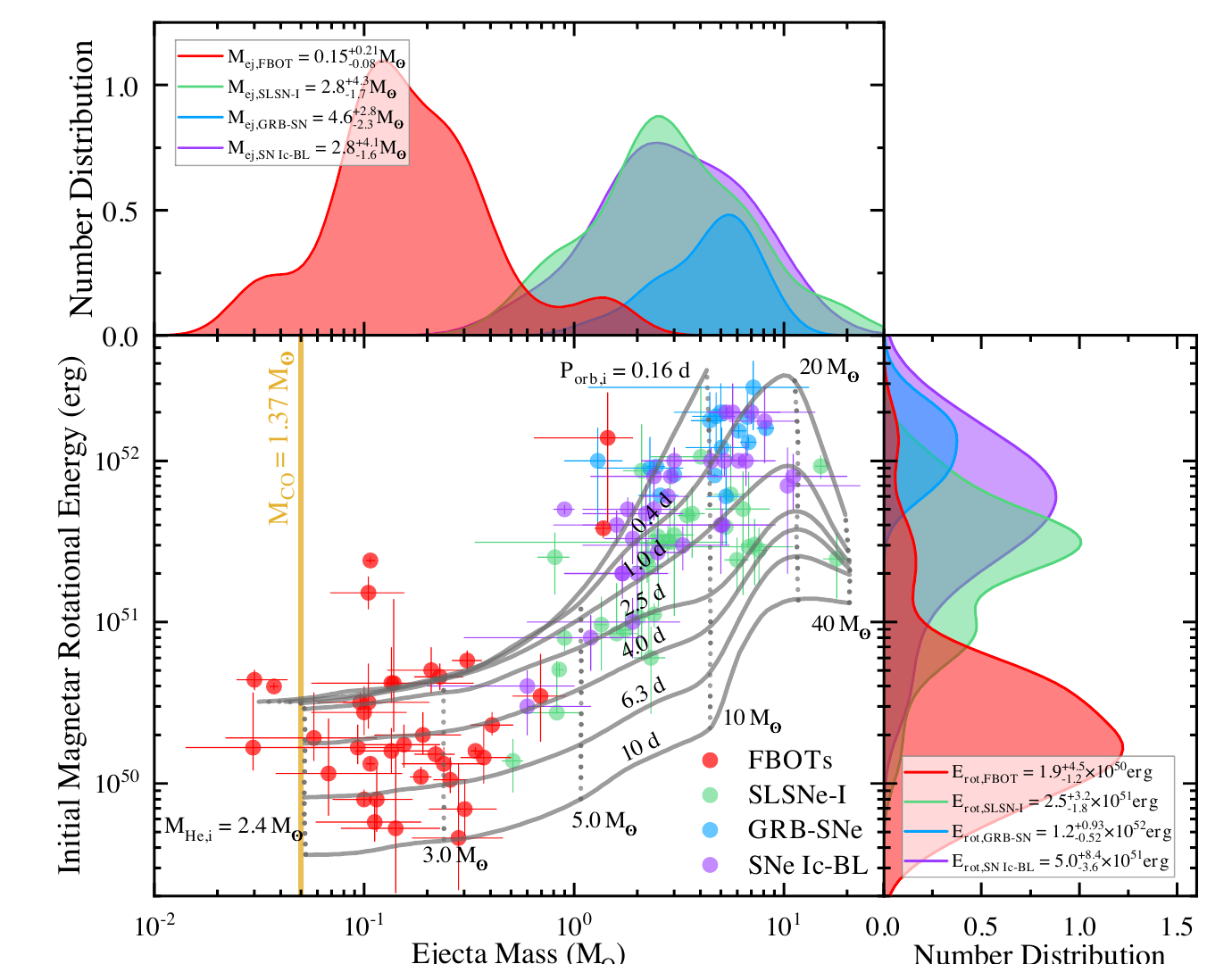
Observationally inferred initial magnetar rotational energies and ejecta masses for fast blue optical transients, Type Ic superluminous supernovae, gamma-ray-burst-associated supernovae, and broad-lined Type Ic supernovae, compared with helium-star binary models at 0.3 times solar metallicity
Figure 1 · Inferred magnetar rotational energies and ejecta masses compared with binary models at 0.3 times solar metallicity.

Formation of Fast-spinning Neutron Stars in Close Binaries and Magnetar-driven Stripped-envelope Supernovae

We model tidal spin-up of helium stars in close binaries as a pathway to forming rapidly rotating magnetars. The models reproduce the inferred relation between magnetar rotational energy and ejecta mass for Type Ic superluminous supernovae, broad-lined Type Ic supernovae, and fast blue optical transients. At the observed metallicities, the models are also consistent with the event rates of these magnetar-driven transients, suggesting that these transients may share a common progenitor pathway.

Magnetar enginesStripped-envelope supernovaeStellar evolution

Compact Binary Formation & Multimessenger Sources

The masses and spins measured in gravitational-wave events carry clues to the lives of their progenitor stars. We study how mass transfer, common-envelope evolution and tidal interactions produce merging compact binaries, using their properties to test formation pathways.

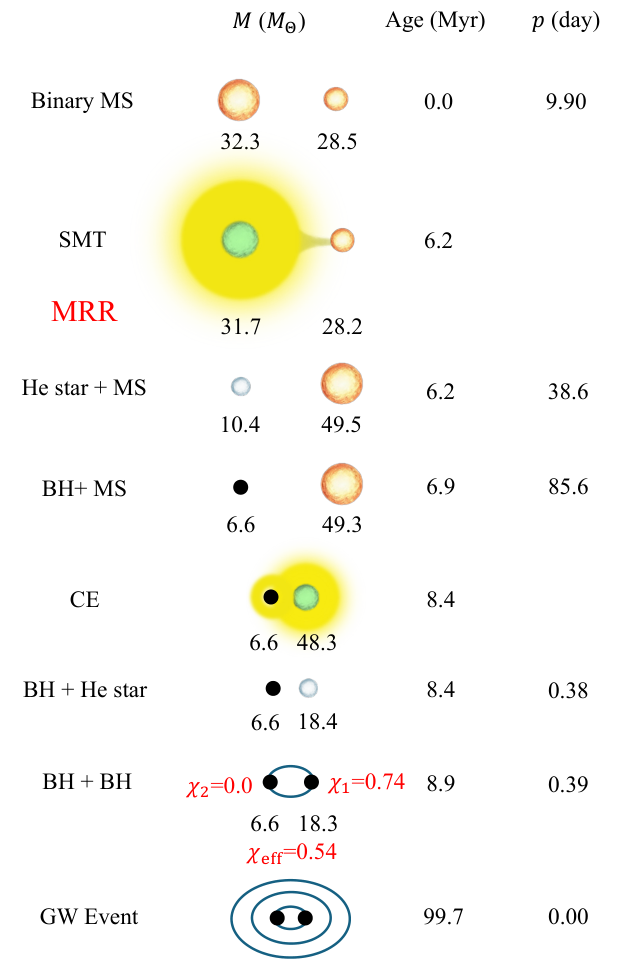
Evolutionary sequence from a main-sequence binary through mass-ratio reversal, common-envelope evolution, and a binary black-hole gravitational-wave event
Figure 1 · Representative mass-ratio-reversal pathway to a GW241011-like merger.

Mass-Ratio Reversal as an Alternative to Hierarchical Mergers for GW241011

GW241011 combines unequal black-hole masses with a rapidly spinning primary. Our population-synthesis calculations identify an isolated-binary pathway in which mass transfer reverses the stellar mass hierarchy, making the more massive black hole form second. Common-envelope ejection tightens the orbit, enabling tides to spin up its helium-star progenitor. Among the models tested, reproducing GW241011 requires a high common-envelope efficiency (α = 5), providing an isolated-binary alternative to hierarchical-merger scenarios.

Binary black holesGravitational wavesPopulation synthesis
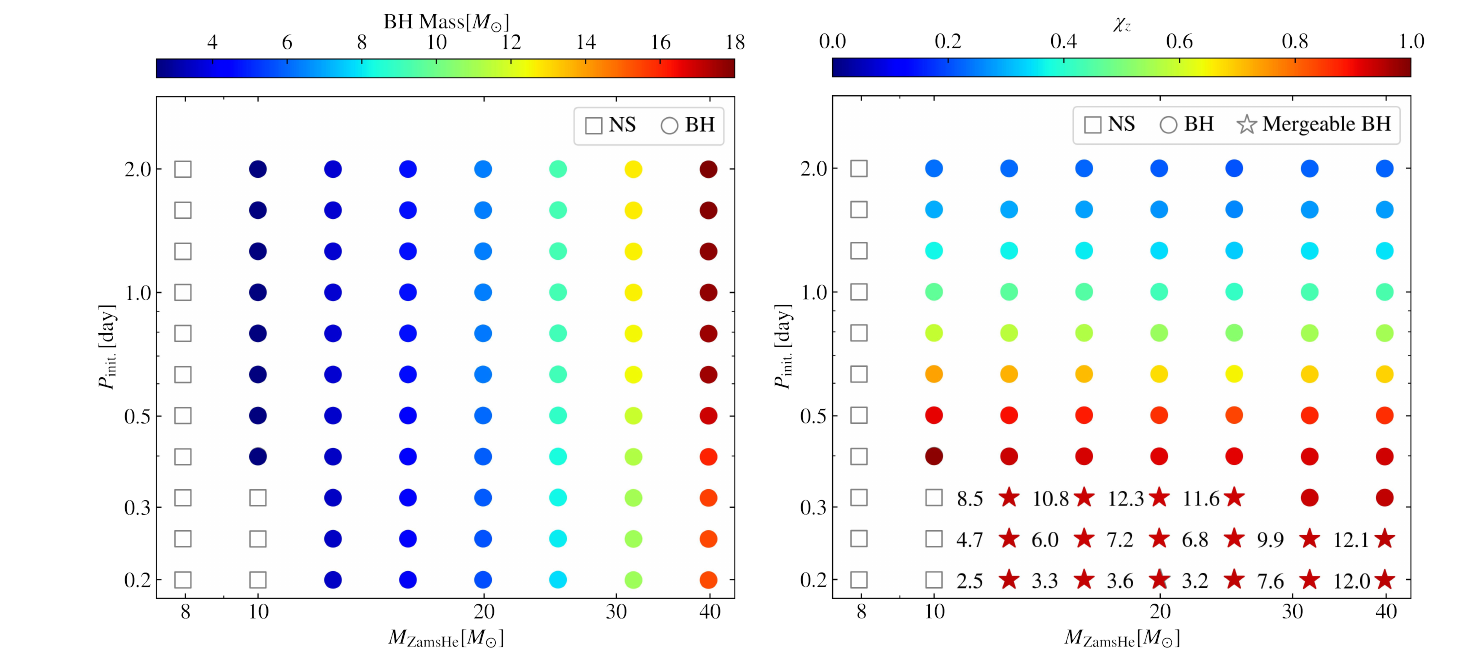
Black-hole masses and spin components aligned with the orbit versus initial helium-star mass and orbital period for binaries with a 1.4-solar-mass neutron-star companion; symbols distinguish remnant types and mark systems merging within a Hubble time
Figure 1 · Black-hole masses and aligned spins in helium-star–neutron-star binaries; star symbols mark mergers within a Hubble time.

A Channel to Form Fast-spinning Black Hole–Neutron Star Binary Mergers as Multimessenger Sources

Electromagnetic emission from a black hole–neutron star merger depends on whether the neutron star is tidally disrupted before being swallowed by the black hole. We identify a formation channel in which the neutron star forms first, while tides spin up its helium-star companion prior to black-hole formation. The resulting black hole can have a large spin component aligned with the orbit, increasing the likelihood of neutron-star disruption and making these systems promising multimessenger sources.

Black hole–neutron starTidal disruptionMulti-messenger astronomy